
3c: Goadby Hall
The Lady and the Spy: A Lifetime of Secrets
Monica Sheriffe, affectionately known as 'Miss Mon' by locals, was born on February 3rd, 1903, at Wyndham Lodge in Melton Mowbray. She was the daughter of Captain Robert Thomas Oliver Sheriffe, a decorated Boer War veteran, and Muriel Vickers. In 1910, the family moved to Goadby Hall, where Monica lived for the rest of her life. A passionate equestrian, she was deeply involved in horse racing, owning several racehorses and amassing an impressive collection of trophies and memorabilia. Monica never married and continued to reside at Goadby until her death in 1999 at the age of 96.
This memoir, told from Monica’s perspective, is narrated by her goddaughter, Vicky.

Elvira Chaudoir – the photo that Elvira gifted to Monica in 1942.
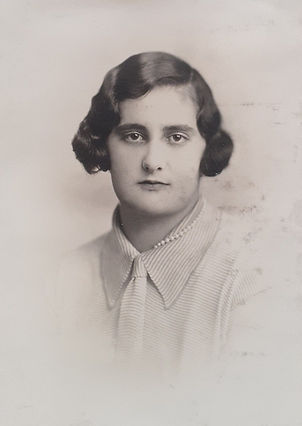
Monica Sheriff circa late 1930s
To learn more about Elvira and Monica visit:
The double agent who hid D-Day from the Nazis:... - The National Archives
The Life & Times of Miss Monica Sheriffe | GoadbyMarwoodHistory
Audio Transcript
They say that a home is just a place—solid stone and mortar. But Goadby Hall was never just that to me. It was where the land shaped my days, and my horses and dogs knew me better than most people ever did.
I was born in 1903 in Melton Mowbray and was brought up properly and thoroughly, as a Sheriffe should be—perhaps that is where my no-nonsense temperament stems from. When I was seven years old, my father leased Goadby Hall from the Duke of Rutland, and in due course was able to purchase the property outright, securing it for our family. That opportunity came in the aftermath of the great Belvoir Estate sale of 1920, when the duke, like many landowners after the Great War, was compelled to sell large portions of his estate. From those earliest moments, the Hall and I began our lifelong relationship. It shaped me, and I shaped it.
I became known in the county for my riding—often astride rather than side-saddle. I would not be constrained by convention. I hunted with the Quorn and Belvoir, raised polo ponies, and started the first ladies’ team when such things were still considered adventurous and avant garde.
I had my share of attachments—men and women alike—and once even declined a perfectly eligible marriage proposal, having no desire to exchange my independence for anyone’s ring.
…… And then there was Elvira ……
I met Elvira Chaudoir in 1940s London. We were both creatures of society, drifting through a world of parties and privilege, but something about her stood apart. She was Peruvian, flamboyant, sharp as a stiletto heel, and entirely at home at a baccarat table. She understood odds—at cards and in life—and she played both without apology.
She would often accompany me on visits to some of the country’s great houses, Chatsworth or Highclere. She took to the countryside with surprising ease for someone so cosmopolitan. At Chatsworth she admired the sweep of the Painted Hall and the cool grandeur of the sculpture gallery and at Highclere she lingered in the great library, inventing scandals for the solemn ancestors on the walls.
What we were to each other requires no embroidery. I kept a photograph of her for more than fifty years, not because I am given to sentimentality and nostalgia, but because I dislike forgetting what matters. In it she wears that look she had when she knew something that no one else did. And she always knew something that no one else did!
During the war years, Elvira would vanish for long stretches at a time. She said little, offered vague explanations. I wasn’t naïve, but I didn’t press her for answers. She once told me, after a few too many sherries by the fireplace, “Mon, if I told you what I really do, you wouldn’t believe me.” Years later, I discovered that she had been a double agent working for the British Secret Service. Codenamed Bronx, she fed the Germans a complex web of lies and false information. One of her tales helped to misdirect the Nazis during the D-Day landings. Imagine that! My Elvira. A hero in silk gloves.
After the war she settled in the south of France. Before she left, we sat comfortably by the fireplace, played bridge and spoke plainly. Time had sharpened her rather than softened her. She told me not to change. I told her I had no intention of doing so.
I remained at Goadby for the rest of my life. I owned race horses—including my glorious Sharpo and Only For Life—and walked the gardens with my dogs each morning. I kept the traditions alive. The village knew me as “Miss Mon,” a figure out of time, perhaps, but solid and steadfast.
If anything of me lingers here now, it is not in wistful air or drifting memory. It is in the straight line of a well-jumped fence and the uncompromising rhythm of hooves on cold ground. That is legacy enough.

