
9: Main Street
The Goadby Boys: A Garden of Memories
Edward Huddlestone was born in 1857 in Goadby Marwood. For much of his adult life, he served as head gardener at Goadby Hall, working for Captain Bertie Sheriffe. Edward lived through the First World War and knew many of the young men from Goadby—affectionately known as “the Goadby Boys”—who tragically lost their lives in the conflict. This story, told from Edward’s perspective, is narrated by Kit, who has lived in Goadby for over 40 years.

Albert Essery
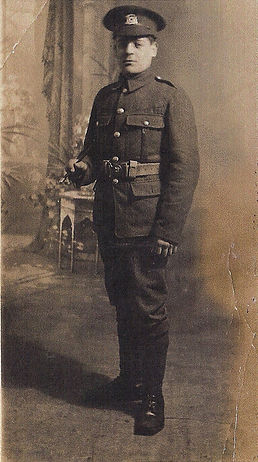
Billy Pizer
Audio Transcript
I remember clear as day that time before the war, and the calm oasis of our idyllic village. I was born here in Goadby Marwood, and for nearly my entire life I have tended the gardens of Goadby Hall—a sanctuary of green amid the chaos of a world at war. I’ve seen plenty of seasons come and go, yet none were as bitter as those dark years of the Great War. Every morning, as I till the soil and coax new life from the earth, I can’t help but think of the bright, brave souls we lost—our beloved “Goadby Boys”.
I often think of young Harry Bottrill, bless him—our undergardener who lodged with my dear Ann and me in our cosy cottage. Harry had a spirit as youthful and hopeful as the first buds of spring. He loved working among the flowerbeds at the Hall, always talking about the life he wanted to build once the world settled down. But in September 1914, the distant drums of war called him away and by the following summer he was far from the comforting embrace of our home. It still pains me to picture that day in 1916, when a stray sniper’s bullet ended his young life. The garden’s never felt quite the same without him.
Then there was Cecil Foister—a solid Goadby lad if ever there was one. He’d had a hard start, what with his dad working the quarry and him losing his mam so young, but Cecil had a grit about him, strong as any of the old beech trees that grace the estate. When he enlisted with the same battalion as Harry, I saw in him the spark of leadership as he rose to Lance Corporal. I recall it was with a heavy heart that we heard the news that on a grey morning in May 1917, during a desperate push at the Second Battle of Bullecourt, Cecil was lost.
And I can’t forget Billy Pizer! I remember his early days, working with his family at Lodge farm on the outskirts of the village, before he answered the call of duty. Billy faced the grim realities of the Somme with remarkable endurance, overcoming wounds that might have broken a lesser spirit, and then returning to the fight. Yet, fate was cruel; in August 1917, during a daring trench raid near Vermelles, he was taken from us for good. He lies now in Philosophe British Cemetery, far from here, though I reckon his spirit still wanders the fields he grew up in.
Not all who fell were young men. Take Albert Essery, for instance—once a footman at the Hall and later the trusted butler—he was the oldest among those who marched off to war. He was a steady sort, always ready with a quiet word of common sense when you needed it. Rising quickly through the ranks to Sergeant Major and earning the Military Medal for his courage, Albert’s leadership shone brightly—even as the darkness of war claimed him at the Battle of Polygon Wood in October 1917.
These days, as I wander the same old paths—past the flowerbeds I’ve tended for years and the beech trees that have stood longer than any of us—I feel the garden is full of stories. I find that every blooming rose, every sprouting daisy, whispers a tale of those lost. These gardens, once a playground of youth and hope, have become a quiet memorial to lives cut short by the ravages of war.
And with each change of season, I feel them close—a whisper in the breeze, a rustle in the hedge. Their graves may lie in France, but their spirits are very much here in Goadby. Ann and me, and the rest of the village folk, keep their memories alive. In this garden of ours, every petal holds a story, every scent a reminder of the lives that once blossomed so brightly.

